
LiDAR robot vacuums ranked by route speed and obstacles
The best LiDAR robot vacuum here is the Dreame L60 Ultra PE at $849.99: 8.0 square feet a minute, 21 of 24 objects dodged. The cheapest robot vacuum with lidar is the Roborock Q7 L5 at $119.99, blind to socks and cables.
Ranked bays
11 robots. The 10 we link to come first.
- 01Top pick8.8/10Empties, washes mops30,000 Pa claimed · LiDAR$849.99L60 Ultra PE
- 029.0/10Empties, washes mops22,000 Pa claimed · Retractable LiDAR$799.99Qrevo CurvX
- 039.0/10Empties, washes mops19,500 Pa claimed · LiDAR$649.99L50 Ultra
- 048.8/10Empties, washes mops31,000 Pa claimed$949.99Flow 2
- 059.5/10Empties, washes mops13,000 Pa claimed$299P10 Pro Ultra
- 069.5/10Empties the bin10,000 Pa claimed · LiDAR$229.99Q10 S5+
- 078.8/10Empties, washes mops35,000 Pa claimed · Retractable LiDAR$989.99X60 Max Ultra
- 088.8/10Empties, washes mops36,000 Pa claimed · 3D ToF$989.99Saros 20
- 099.5/10Empties the bin13,000 Pa claimed$249.99D20 Plus
- 109.3/10Charges only8,000 Pa claimed · LiDAR$119.99Q7 L5
Show 1 more
- 119.8/10Empties, washes mops30,000 Pa claimed · LiDAR$499Read review
Head to head
| Robot | Score | Price | Height | Source |
|---|---|---|---|---|
| Dreame L60 Ultra PE | 8.8 | $849.99 Black Friday | 4.09 in (103.8 mm) | Dreame store, Nov 25 |
| Roborock Qrevo CurvX | 9.0 | $799.99 | 3.14 in (79.8 mm) | Roborock store, Nov 24 |
| Dreame L50 Ultra | 9.0 | $649.99 Black Friday | 3.82 in (97 mm) | Dreame store, Nov 25 |
| Narwal Flow 2 | 8.8 | $949.99 Black Friday | 3.74 in (95 mm) | Narwal store, Nov 25 |
| Mova P10 Pro Ultra | 9.5 | $299 Black Friday | 3.82 in (97 mm) | Mova store, Nov 24 |
Running costs
Robot price and one set of the parts the brand store lists.
| Robot | Price | One set of listed parts | Parts listed | Source |
|---|---|---|---|---|
| Dreame L60 Ultra PE | $849.99 | $149.99 | 1 | Dreame parts, Nov 24 |
| Roborock Qrevo CurvX | $799.99 | $25.59 in-stock parts only | 3 | Roborock parts, Nov 24 |
| Dreame L50 Ultra | $649.99 | $97.97 | 3 | Dreame parts, Nov 24 |
| Narwal Flow 2 | $949.99 | $62.97 in-stock parts only | 4 | Narwal parts, Nov 24 |
| Mova P10 Pro Ultra | $299 | $27.99 in-stock parts only | 4 | Mova parts, Nov 24 |
| Roborock Q10 S5+ | $229.99 | $74.57 in-stock parts only | 4 | Roborock parts, Nov 24 |
| Dreame X60 Max Ultra Complete | $989.99 | $108.96 | 4 | Dreame parts, Nov 24 |
| Roborock Saros 20 | $989.99 | $25.59 in-stock parts only | 2 | Roborock parts, Nov 24 |
| Dreame D20 Plus | $249.99 | $117.87 | 3 | Dreame parts, Nov 24 |
| Roborock Q7 L5 | $119.99 | $10.19 | 1 | Roborock parts, Nov 24 |
A lidar robot vacuum knows where it is. The laser on top measures the room, the app draws a map, and the robot cleans in rows, where a basic robot vacuum cleaner bounces off walls. Lidar technology is common now even on the cheapest models, so the useful question is how well each one drives and what it does when a cable lies in the way.
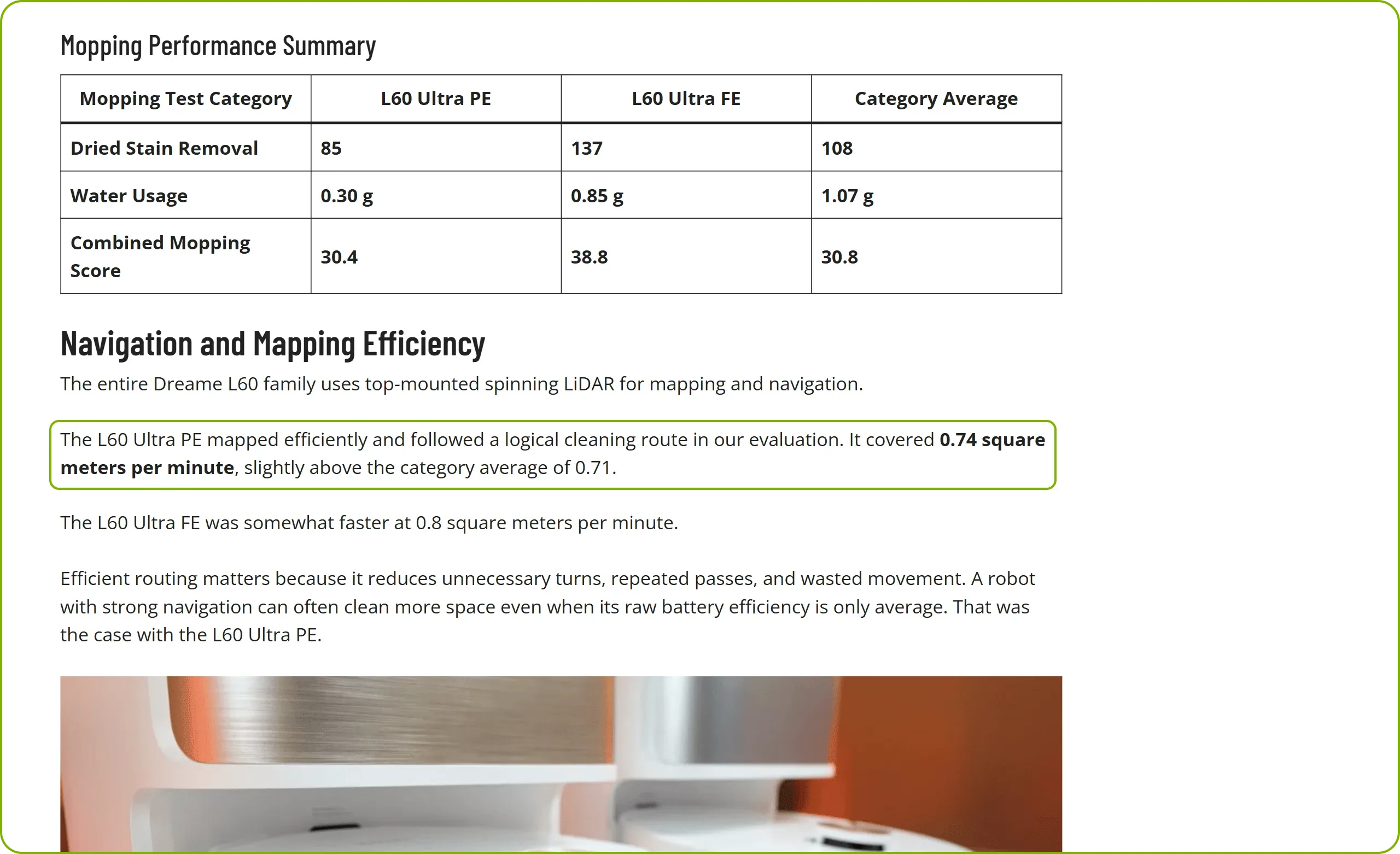
This page ranks eleven robots on two lab numbers from Vacuum Wars: how many square feet of a fixed floor plan the robot covers in a minute, and how many of 24 household objects it avoids. First place goes to the Dreame L60 Ultra PE, which beats its review average on both.
How a robot got onto this list
Every robot had to use lidar navigation, confirmed by the brand’s spec page or by Vacuum Wars, be in stock new at the brand’s US store on November 25, 2026, and have a measured navigation figure or a stated result against average.
The order follows one rule: first come robots whose navigation beat the average of their own review, sorted by objects avoided, and robots below that average or with no obstacle system follow. Ties on objects go to the faster route. The Ecovacs sits last only because we have no link to its store. Suction power, pet hair pickup and mopping don’t move the order. Our pet hair list ranks on those.
One strong robot is missing on purpose. The Narwal Freo 20 avoided 23 of 24 objects, but Narwal’s product page names two 1080p cameras and no laser at all, so it is a camera robot. It ranks on our general list instead.
Turret, retractable or built in
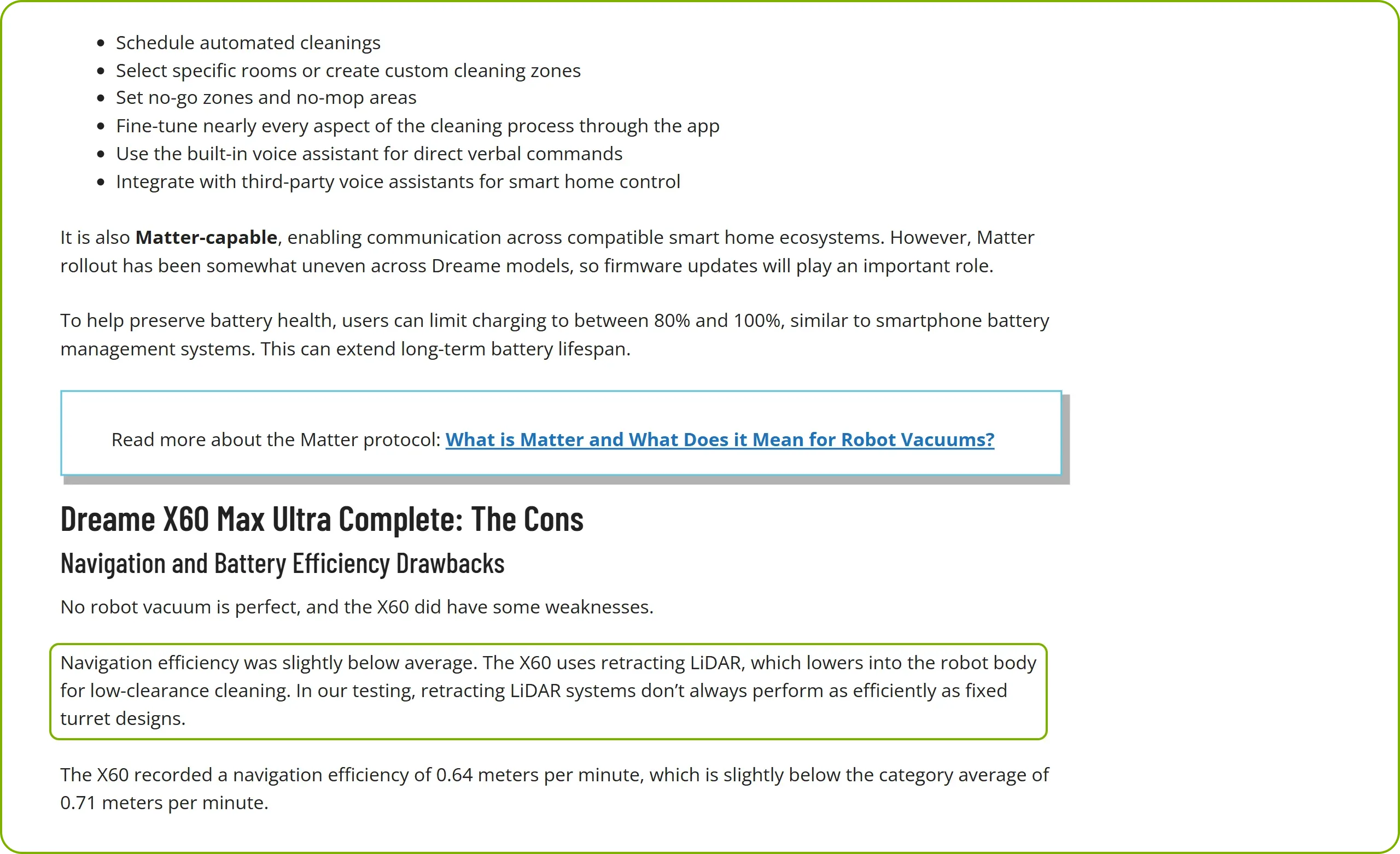
Lidar navigation systems come in three shapes. The classic design is a fixed round turret. It sees 360 degrees all the time, and Vacuum Wars, in its X60 Max review, writes that retracting LiDAR systems don’t always perform as efficiently as fixed turret designs. The cost is height. The L60 Ultra PE stands 4.09 in (103.8 mm), the tallest robot here, and the whole L60 family uses a top-mounted spinning LiDAR. The Q10 S5+ and Q7 L5 are 3.9 in (99 mm), the L50 and P10 3.82 in (97 mm).
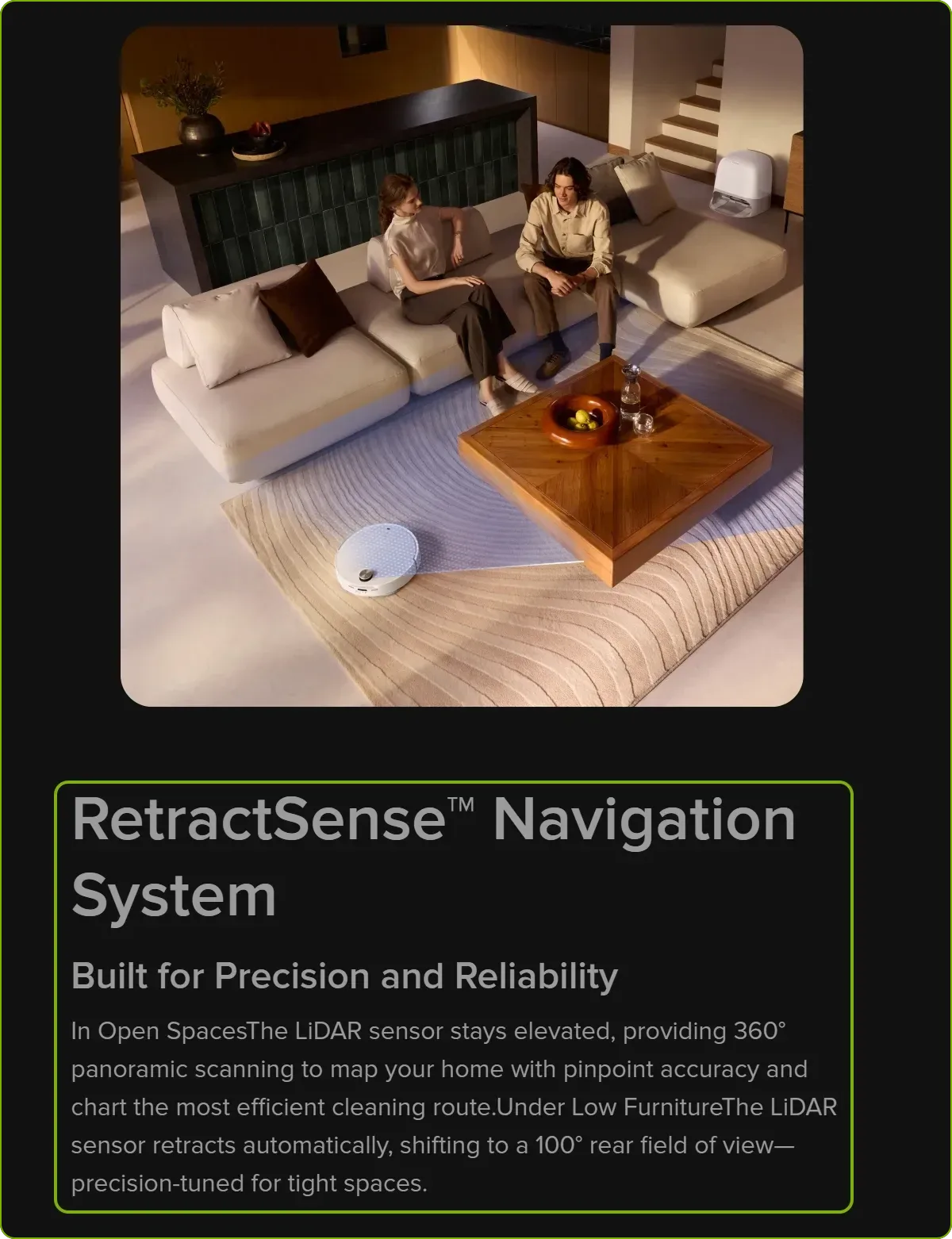
A retractable turret drops into the body to pass under low furniture. Roborock calls its version on the Qrevo CurvX RetractSense: raised, the laser scans 360 degrees. Lowered, it switches to a 100-degree view to the rear, and the robot fits under 3.14 in (79.8 mm). The X60 Max does the same at 3.13 in (79.5 mm), and its 6.9 square feet a minute shows the trade.
The third way hides the laser in the shell. The Saros 20 uses a solid-state 3D sensor with no tower, also at 3.14 in, and lands right around average for navigation. The T90 Pro Omni carries what Vacuum Wars calls an embedded LiDAR system integrated into the robot’s body, at 3.74 in (95 mm). The Narwal Flow 2, at the same height, pairs lidar with side structured-light sensors, and the lab noticed that it moves through a room in an unusual pattern.
Measure the gap under your sofa and bed before you choose. Under 3.8 inches, only the retracting and built-in designs go all the way through: the L50 and P10 stand 3.82 in.
The laser maps, a second sensor dodges
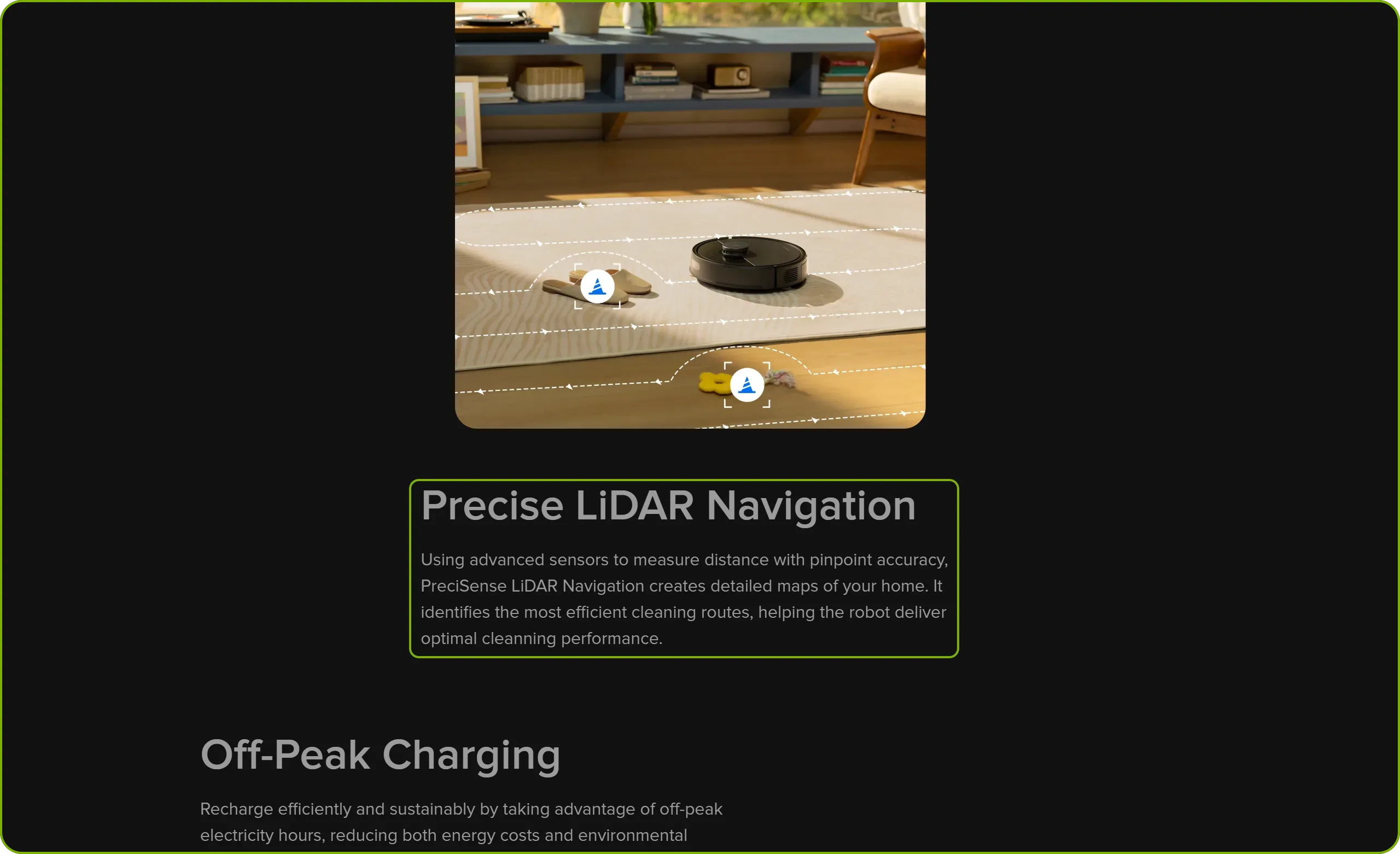
Lidar sits above the floor and looks out at walls and legs, so a phone charger or a sock lies under its beam. Obstacle avoidance needs a second system that can detect objects low on the floor and steer around obstacles, and the column on the right of the table above is really a test of that system.
- Camera plus light: the L60 Ultra PE pairs a camera with a 3D time-of-flight sensor, and the P10 Pro Ultra uses a camera with 3D structured light and an LED. Both stay near the top on obstacle detection.
- Structured light alone: the Q10 S5+ has it without a camera and avoided 6 of 24.
- Nothing: the D20 Plus scored 0, and the Q7 L5 has no system to test. Their lidar keeps them off walls and out of corners, but they will chew up whatever lies on rugs or hardwood floors.
Light matters only to the second sensor. Narwal, which sells both kinds, writes in its lidar-versus-camera guide that a lidar robot “navigates smoothly even in dark or cluttered areas”, while cameras need light. The T90, the P10 and the X60 Max, which Dreame fits with what it calls Proactive Illumination, carry their own light for the camera.
Which LiDAR robot fits your home
Best overall: Dreame L60 Ultra PE. Above average on route and on objects, with a dock that empties the bin and washes the mop, and three years of warranty. Check the height first, and the last two letters: the L60 Ultra FE drives faster at 8.6 square feet a minute but avoided only 2 of 24.
Low beds and couches: Roborock Qrevo CurvX. It drives faster than the L60 Ultra PE, avoids one object fewer, and has the lowest body of the top six once the turret folds down. Roborock gives it one year of warranty, against three on the Dreames.
A lidar robot vacuum and mop for less: Dreame L50 Ultra. The same 20 objects as the CurvX, a laser on top, and a dock with mop washing at $649.99.
Two sensors on the laser: Narwal Flow 2. It matched the L50 on navigation and objects, using side structured light alongside the lidar. It is the most expensive of the top four, at $949.99.
Most robot for the price: Mova P10 Pro Ultra. Two Vacuum Wars reviews put its navigation above average, and at $299 it costs less than any other robot here with a camera for obstacles. Mova lists maps for four levels.
Cheapest robot vacuum with lidar and a dock: Roborock Q10 S5+. It covers 8.8 square feet a minute and empties itself, at $229.99. Pick up the floor before it runs.
Thresholds and tight spaces: Dreame X60 Max Ultra Complete. The flattest body here with 22 objects avoided. Slow routes are the price of the folding laser.
Tall sills, solid-state sensor: Roborock Saros 20. No tower to snag, 17 objects avoided, and the lab saw it climb a 2.24 in (57 mm) step.
Large, clear floors on a budget: Dreame D20 Plus. Above-average coverage and a long battery, at $249.99, for homes where nothing lies on the rug.
The lowest price: Roborock Q7 L5. At $119.99 it maps rooms and drives clean paths as well as robots four times its price. There is no obstacle system and no dock.
Maps for more than one floor
Multi-floor mapping is where lidar pays off upstairs. Carry the robot to another level and it recognizes the floor from the map it saved, with its own rooms and no-go zones. The P10 Pro Ultra stores four maps, Mova says, and Roborock lists multi-level maps on the Q7 L5 and Q10 S5+, as Dreame does on the D20 Plus. If your stairs split a house into three levels, check the map count before anything else, because a docking station still has to sit on one of them.
What owners report breaking
The tower is the one moving part a camera robot doesn’t have, and Reddit threads show what can go wrong with it. Each line is one household’s cleaning experience.
- Turret stuck halfway (r/Roborock, November 6, 2026). A Saros 10 raised its laser about halfway and reported a sensor error. A reply pointed to a teardown video that fixed it without a new turret.
- Turret stuck up (r/Dreame_Tech, October 2, 2026). A Dreame lifted its lidar and wouldn’t lower it. The app has a setting to lower it by hand.
- Shell knocked off (r/Dreame_Tech, October 10, 2026). An X40 Pro Ultra missed a low edge, didn’t retract, and cracked the lidar cover. Out of warranty, the advice was glue.
- Sensor won’t spin (r/RobotVacuums, November 23, 2026). After two years, a Q Revo Pro’s lidar stopped turning even after cleaning. A new unit runs about 120 euros.
- Error after a chair forest (r/Roborock, October 21, 2026). A new Saros 20 Neo mapped two floors fine, then showed lidar error 1 after running under a table and four chairs.
- Noisy lift (r/Dreame_Tech, November 22, 2026). An X50 Ultra’s tower hums and wobbles going up and down. Another owner says several of their lifting models do the same.
Fixed turrets fail less often in these threads than lifting ones, which is the other side of the low-furniture trade.
Ecovacs: laser inside the shell
The Ecovacs DEEBOT T90 Pro Omni avoided 23 of 24 objects, the best result on this page, and covered 8.1 square feet a minute against a 7.6 average, at $499. Its lidar sits inside the body rather than on a tower, and an LED lights the way for its obstacle sensor. Ecovacs gives one year of warranty. We have no link to its store, and the nearest robot with one on both counts is the L60 Ultra PE: two fewer objects avoided, a slightly slower route, and three years of cover.
- $351 more at the brand store
- 3-year vs 1-year warranty
The T90 Pro Omni review has the rest.
Does Roomba have LiDAR?
Yes, the robots iRobot sells today map with lidar: the Roomba 105, 205, the Plus 405 to 678 and the Max 705 and 715, twelve in our file. The 105 Vac is the only one with a navigation figure from the lab we use, 8.0 square feet a minute in its Vacuum Wars review (updated September 18, 2026). The j9+ and Combo 10 Max still navigate by camera. Our Roomba overview covers which models are current.
Quick answers
Is LiDAR good for robot vacuums?
For navigation, yes. A spinning laser measures the distance to walls and furniture, so the robot builds a floor plan, cleans in straight rows and goes back to the right room. Nine of the eleven robots here beat the lab average for floor covered per minute. What lidar doesn’t do is spot small things on the floor. For that you need a camera or structured light as well.
What is a LiDAR robot?
It is a robot vacuum that maps rooms with a laser rangefinder, usually in a small round tower on its top. The laser sweeps 360 degrees, timing how long light pulses take to bounce back, and the app turns that into a map with rooms you can name, split and fence off.
Do LiDAR robot vacuums work in the dark?
The mapping does. Lidar sends out its own light, so a dark bedroom doesn’t confuse it, and Narwal’s own explainer says the same. A camera used for obstacle detection needs some light, which is why the T90 Pro Omni, P10 Pro Ultra and X60 Max carry LEDs on the front.
Is a LiDAR or a camera robot vacuum better?
Most good robots now carry both. Lidar does the map and the route, a camera or structured light picks out shoes and cords. If you must pick one, lidar gives the more reliable map, while a camera-only robot can lose its way in low light. The Narwal Freo 20, which navigates with two cameras, is a strong robot that we left off this list for that reason alone.
Does Roomba have LiDAR?
The current line does. Of the iRobot robots on sale that we track, twelve map with lidar, from the Roomba 105 to the Max 715. The j9+ and Combo 10 Max use a camera instead. Only the 105 Vac has a published navigation figure, 8.0 square feet a minute.
What is the absolute best robot vacuum right now?
That depends on what counts. This page weighs navigation and obstacles only. Our best robot vacuums ranking also counts price, warranty, recalls and owner reviews, and the comparison table holds every robot we have data on.